Eric Steinhart
Philosophical Writing
Books
These topic areas contain abstracts of papers and downloadable copies.
Atheistic Platonism: A Manifesto
Steinhart, E. (2022) Atheistic Platonism: A Manifesto New York: Palgrave Macmillan.
Get Atheistic Platonism.
Atheistic Platonism is an alternative to both theism and nihilistic atheism. Where atheisms based on materialism fail, atheisms based on Platonism succeed. Atheistic Platonism provides reality with foundations that are eternal, necessary, rational, beautiful, and utterly mindless. It argues for a plenitude of mathematical objects, and an infinite plurality of possible universes. Atheistic Platonism provides mindless rational grounds for objective values, and for objective moral laws for the persons who evolve in universes. Atheistic Platonism defines a meaningful and spiritually deep way of life, which facilitates ethical self-improvement. Atheistic Platonism includes computational theories of life after death, in which humans ascend through transhuman and superhuman degrees of animal excellence. Atheistic Platonism includes a rich system of spiritual symbols. It values transformational practices and ecstatic experiences.
Table of Contents
Chapter Abstracts
Atheistic Platonism Articles
Steinhart, E. (In press) Non-theistic Optimism in Recent Philosophy. In J. Daeley (Ed.) (20xx) Optimism and the Best Possible World: A Philosophical History. New York: Routledge, xx-xx.
ABSTRACT: Optimism (also sometimes called optimalism or axiarchism) says the best is productively responsible for the existence of all things. Despite its ancient Platonic pedigree, optimism has failed to flourish in recent analytic philosophy. Here I aim to support it by showing how it helps to solve problems in the foundations of logic, mathematics, and cosmology. I use reasoning from analytic metaphysics to justify the existence of the One, which points to the Good. Following Neoplatonism, I outline five optimal emanations: the One emanates the Best Logic, the Best Class Theory, the greatest model of that Best Class Theory, the Best World, and the greatest model of that Best World. I show how optimism helps to define the class of possible universes in a variant of Lewisian modal realism. While optimism is often thought to support monotheism, the optimism developed here is non-theistic. It is a kind of atheistic metaphysical Platonism. Nevertheless, it supports a polytheistic hierarchy of non-theistic deities.
Steinhart, E. (2024) The Joyous Cosmology. In S. Gaeb & D. Reisinger (Eds.) (2024) Philosophie der Spiritualitat / Philosophy of Spirituality. Berlin: Schwabe Verlag, 157-174.
ABSTRACT: The joyous cosmology portrays our universe, and nature itself, as a world of positive value and meaning. It is found in the Stoics, Nietzsche, and Alan Watts. I use the phrase to describe an ecstatic and spiritual vision of our universe, based on our best current science. It entails amor natura, the agape love of (and for) nature. To participate in this love is to bear witness to the Good. Developing an idea from Masahiro (2021), I will show that to participate in amor natura is to vicariously become the ground of being, that is, being-itself, speaking with a soundless voice, which says ?I am here? to the Good. When this voice speaks in and through you, your agape love for nature becomes ecstatic. This is a naturalistic account of the ecstatic meaning of mystical experience.
Platonism
Steinhart, E. (2019) Neoplatonic Pantheism Today. European Journal for Philosophy of Religion 11 (2), 1-22.
ABSTRACT: Neoplatonism is alive and well today. It expresses itself in New Thought and the mind-cure movements derived from it. However, to avoid many ancient errors, Neoplatonism needs to be modernized. The One is just the simple origin from which all complex things evolve. The Good, which is not the One, is the best of all possible propositions. A cosmological argument is given for the One and an ontological argument for the Good. The presence of the Good in every thing is Spirit. Spirit sits in the logical center of every body; it is surrounded by the regulatory forms of that body. Striving for the Good, Spirit seeks to correct the errors in its surrounding forms. To correct the errors in biological texts, modern Neoplatonists turn to the experimental method. This Neoplatonism is pantheistic not because of some theoretical definition of God but rather because of its practical focus on the shaping of Spirit.
Steinhart, E. (2015) You Ought to Flourish. A talk based on this paper was presented to the Philosophy Department at Bloomsburg University, Bloomsburg PA, on 22 October 2015.
ABSTRACT: You ought to flourish. Since you ought to flourish, it will be argued here that your life is the root of an infinitely ramified tree of ever better lives. Your life will be surpassed by successor lives in successor universes. And those lives and universes will in turn be surpassed by their successors. After you die, you will live again. You will be reborn in all your future lives. But lives and universes and laws are natural. Hence naturalists can believe in life after death. On this optimistic naturalism, nature is as it ought to be. Nature is the self-surpassing surpasser of all.
Steinhart, E. (2015) Six Axiarchic Arguments. Research report.
ABSTRACT: Axiarchism argues that concrete reality is ultimately generated by the logic of value. Although axiarchism has produced an interesting literature spanning nearly five decades, it is hard to find any explicitly stated axiarchic arguments. I derive axiarchic arguments from the texts of Kiteley, Ewing, Rescher, Leslie, and Millican. For each argument, I state the axiarchic principle which links abstract value to concrete existence. Most of these principles are hard to justify. But there is a justification for the axiarchic principle derived from Leslie. All these axiarchic arguments fall prey to a well-known objection. So I will add a sixth axiarchic argument which avoids that objection.
Steinhart, E. (2012) Axiarchic Polytheism. Talk at Birmingham Workshop on Alternative Conceptions of God. University of Birmingham, England. 19 July 2012.
ABSTRACT: John Leslie has developed a novel type of Platonic theology. Abstract goodness manifests itself in an axiarchic principle: for all p, if it ought to be the case that p, then p. The manifestation of goodness thereby satisfies all axiological demands for existence. According to Leslie, the greatest axiological demand is the demand for a proper class of absolutely infinite divine minds. However, that proposal suffers from fatal mathematical flaws. Proper analysis of the structure of this class shows it to be a hierarchy of increasingly intelligent and powerful divine minds. The universes in these minds form a system for quantified modal logic and counterpart theory. Axiarchic theology is a significant alternative to Abrahamic theologies. Axiarchic theology is polytheistic and may serve as a metaphysical basis for a Platonic neopagan religion.
Steinhart, E. (2010) Platonic Atheism. Research Report.
ABSTRACT: Platonic atheism is an affirmative atheism. It affirms modern analytic metaphysics and ethics. The platonic atheist is a metaphysical and moral realist. Reality is lawful. The Law includes the laws of logic, mathematics, actuality, and morality. All things fall under the Law. Gods exist only if the Law permits them to exist. The existence of any god is a scientific question. And if any gods do exist, they are subject to the Law. Hence science decides what the gods can and cannot do. Any actions of any gods can be evaluated using the moral laws. Platonic atheism allows the soul to be defined as the form of the body. It allows for life after death via lawful resurrection in other universes. Since all persons are equal before the law, platonic atheists are committed to justice. For the platonic atheist, the Law is divine. The projection of any King above the Law is idolatry. The platonic atheist has a rich system of atheological concepts (piety, impiety, eschatology, soteriology, etc.). Platonic atheism liberates religion from theism.
Steinhart, E. (2010) The Striving Possibles. Research report.
ABSTRACT: Why is there something rather than nothing? Leibniz offered a surprising answer to this question with his theory of the striving possibles. His theory was that possible objects strive to become actual things. More perfect possibilities strive more intensely. All the possibilities compete with each other, and the best possibilities win the competition to become actual. Leibniz has a surprisingly modern analysis of the concept of perfection. Possibilities are bit strings, and their perfections are their complexities. The theory of the striving possibles can be formulated in evolutionary terms.
Logic
Steinhart, E. (2005) Nietzsche on Identity. Revista di Estetica 28 (1), 241 - 256.
ABSTRACT: I gather and constructively criticize Nietzsche's writings on identity. Nietzsche treats identity as a logical fiction. He denies that there are any enduring things (no substances); he denies that there are any indiscernible things in any respect (no universals, no bare particulars). For Nietzsche, the world consists of durationless events bearing non-universal properties and standing to one another in non-universal relations. Events are bundles of tropes. Nietzsche even denies self-identity. His events are self-differing trope-bundles. I link Nietzsche's denial of self-identity with modern treatments of paradox.
More Precisely
Steinhart, E. (2009/2017) More Precisely: The Math You Need To Do Philosophy Vancouver, BC: Broadview Press.
ABSTRACT OF BOOK: More Precisely is a mathematics book for philosophers. It introduces the formal tools used in philosophy, and illustrates the applications of those tools with examples from both classical and contemporary philosophy. More Precisely is illustrated with many examples taken from many branches of philosophy - including metaphysics, philosophy of mind, philosophy of language, epistemology, ethics, and philosophy of religion. It shows how the mathematics is directly applied to philosophy. Second Expanded Edition 2017.
Mathematics
Steinhart, E. (2003) Why Numbers are Sets. Synthese 133, 343-61.
ABSTRACT: I follow standard mathematical practice and theory to argue that the natural numbers are the finite von Neumann ordinals. I present the reasons standardly given for identifying the natural numbers with the finite von Neumann's (e.g. recursiveness; well-ordering principles; continuity at transfinite limits; minimality, and identification of n with the set of all numbers less than n). I give a detailed mathematical demonstration that 0 is {} and for every natural number n, n is the set of all natural numbers less than n. Natural numbers are sets. They are the finite von Neumann ordinals.
Steinhart, E. (2007) Infinity. In J. Lachs & R. Talisse (Eds.) Encyclopedia of American Philosophy. New York: Rougledge.
ABSTRACT: I review the evolution of the concept of infinity in the work of classical American philosophers, primarily Charles Sanders Peirce and Josiah Royce.
Steinhart, E. (1999) Nietzsche's Philosophy of Mathematics. International Studies in Philosophy 31 (3), 19 - 27.
ABSTRACT: Nietzsche has a surprisingly significant and strikingly positive assessment of mathematics. I discuss Nietzsche's theory of the origin of mathematical practice in the division of the continuum of force, his theory of numbers, his conception of the finite and the infinite, and the relations between Nietzschean mathematics and formalism and intuitionism. I talk about the relations between math, illusion, life, and the will to truth. I distinguish life and world affirming mathematical practice from its ascetic perversion. For Nietzsche, math is an artistic and moral activity that has an essential role to play in the joyful wisdom.
Computation
Steinhart, E. (2007) Infinite Machines. In A. Schuster (Ed.), Intelligent Computing Everywhere. New York: Springer, 25-43.
ABSTRACT: Infinite machines (IMs) can do supertasks. A supertask is an infinite series of operations done in some finite time. Whether or not our universe contains any IMs, they are worthy of study as upper bounds on finite machines. We introduce IMs and describe some of their physical and psychological aspects. An accelerating Turing machine (an ATM) is a Turing machine that performs every next operation twice as fast. It can carry out infinitely many operations in finite time. Many ATMs can be connected together to form networks of infinitely powerful agents. A network of ATMs can also be thought of as the control system for an infinitely complex robot. We describe a robot with a dense network of ATMs for its retinas, its brain, and its motor controllers. Such a robot can perform psychological supertasks it can perceive infinitely detailed objects in all their detail; it can formulate infinite plans; it can make infinitely precise movements. An endless hierarchy of IMs might realize a deep notion of intelligent computing everywhere.
Steinhart, E. (2002) Logically Possible Machines. Minds and Machines 12 (2), 259-80.
ABSTRACT: I use modal logic and transfinite set-theory to define metaphysical foundations for a general theory of computation. A possible universe is a certain kind of situation; a situation is a set of facts. An algorithm is a certain kind of inductively defined property. A machine is a series of situations that instantiates an algorithm in a certain way. There are finite as well as transfinite algorithms and machines of any degree of complexity (e.g. Turing and super-Turing machines and more). There are physically and metaphysically possible machines. There is an iterative hierarchy of logically possible machines in the iterative hierarchy of sets. Some algorithms are such that machines that instantiate them are minds. So there is an iterative hierarchy of finitely and transfinitely complex minds.
Steinhart, E. (2002) Ordinal Machines Research Report.
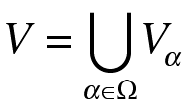
ABSTRACT: I aim to extend the concepts of algorithms and machines arbitrarily far into the set-theoretic hierarchy of mathematical objects. I work within the universe V of sets defined by Von Neumann - Bernays - Godel class theory (VBG) and the von Neumann theory of ordinal numbers developed in VBG. Since the theory of ordinals is essential to the theory of these machines, I refer to them as ordinal machines.
Believing in Dawkins
Steinhart, E. (2020) Believing in Dawkins: The New Spiritual Atheism New York: Palgrave Macmillan.
Get Believing in Dawkins.
The atheism of Richard Dawkins has been attacked by many theists; yet it has not been defended by atheists. I am an atheist and I will defend Dawkinsian atheism. Believing in Dawkins entirely ignores God.
The present task for atheists and naturalists is to build a positive culture, one in which people can live fulfilling lives. Believing in Dawkins focuses on building new naturalistic cultures that are aesthetically, emotionally, morally, and spiritually rich and satisfying. Theism has hijacked our most valuable concepts and practices, and it's time to reclaim them. Believing in Dawkins begins this reclaiming.
Table of Contents
Chapter Abstracts
Videos
Evolution
Steinhart, E. (2025) The Painful Holiness of the Real Asian Journal of Philosophy. DOI 10.1007/s44204-025-00281-z.
ABSTRACT: Yujin Nagasawa's book, The Problem of Evil for Atheists, aims to show how theists, pantheists, axiarchists, and atheists all share a problem. On the one hand, they posit some cherished entity (God, nature, evolution, etc.). On the other, this cherished entity either causes or contains suffering, which is apparently incompatible with their cherishing. To solve their problem, these groups can and have turned to holiness. A holy entity can be cherished even if it causes or contains suffering. Hence their shared solution revolves around a common core, which I link with John Hick's Real. Nagasawa adds pantheism, axiarchism, and atheism to Hick's pluralism. By doing this, he strips the Real of residual monotheistic features which might make it idolatrous. For those who oppose idolatry, Nagasawa opens up a vast new territory of religious opportunities.
Steinhart, E. (2016) Divine Sexuality. Talk presented at the Mormon Transhumanism Association Conference, Provo UT, 9 April 2016.
ABSTRACT: A crane is an process in which simpler things evolve into more complex things. All cranes depend on some ultimate crane composed of evolving titans. Titans resemble organisms. They evolve into divine male-female reproductive dyads, which design and create ever more complex universes. As universes gain complexity, they contain inner cranes nested in things in outer cranes. They contain exaltations nested in exaltations. Inner cranes recapitulate the histories of their outer cranes. As cranes become nested, human reproductive dyads will become exalted into superhuman networks designing and creating their own software universes.
Steinhart, E. (2016) Dawkinsian Metaphysics Research Report.
ABSTRACT: A little digging reveals an intriguing metaphysical system in the texts of Richard Dawkins. Since universes are complex, the Dawkinsian account of complexity entails that they evolved. An extensive study of the Dawkinsian texts supports a titanic interpretation of cosmic evolution. The titans resemble asexually reproducing and recursively self-upgrading computers. As titans evolve, they run increasingly complex universes. Dawkinsian metaphysics supports an intriguing new type of evolutionary lifestyle, which includes nontheistic religious and spiritual practices. These new practices are already socially challenging the theistic religions.
Steinhart, E. (2012) Gods Evolve Research Report.
ABSTRACT: According to theological naturalism, every divine object is natural, and some natural objects are divine. On the basis of the design arguments, theological naturalists argue for an infinite plurality of divine objects. All divine objects are natural gods. Natural gods fall within the scopes of several sciences, including computer science, the sciences of information and complexity, and the sciences of the functional organization of minds and organisms. Natural gods are increasingly complex objects. Since they are complex, they are produced through gradual accumulations of complexity. Divine lineages slowly climb Mount Improbable. Gods evolve.
Steinhart, E. (2014) The World Tree. Research report.
ABSTRACT: An optimistic picture of nature will be painted here. Although it is a deeply religious picture manager, is also radically atheistic. It is a type of religious or spiritual naturalism. A cosmological argument is used to justify the existence of a simple initial object; but that object is not God. An ontological argument is used to justify the principle that every natural thing surpasses itself in every possible way. Nature is an endlessly ramified tree of ever better worlds. These worlds and the things they contain serve as a domain for modal quantification. Your current earthly life will be surpassed by better lives in better worlds. After you die, you will be born again.
Demiurges
Steinhart, E. (2019) Process Polytheism. In D. Wheeler & D. Conner (Eds.) Conceiving an Alternative: Philosophical Resources for an Ecological Civilization. Claremont, CA: Process Century Press, 149-65.
ABSTRACT: I develop a version of process theology inspired by Hartshorne. This development aims to reconcile Hartshorne both with recent science and with analytic metaphysics. It posits an endless series of ever greater cosmic epochs. Each cosmic epoch is a subcomputation in a divine mind. But each divine mind is like a Phoenix. Just as new cosmic epochs are born from the ashes of old cosmic epochs, so new gods are born from the ashes of old gods. The result is a process polytheism.
Steinhart, E. (2013) On the Plurality of Gods. Religious Studies 49 (3), 289-312.
ABSTRACT: Ordinal polytheism is motivated by the cosmological and design arguments. It is also motivated by Leibnizian-Lewisian modal realism. Just as there are many universes, so there are many gods. Gods are necessary concrete grounds of universes. The god-universe relation is one-to-one. Ordinal polytheism argues for a hierarchy of ranks of ever more perfect gods, one rank for every ordinal number. Since there are no maximally perfect gods, ordinal polytheism avoids many familiar problems of monotheism. It links theology with counterpart theory, mathematics and computer science. And it entails that the system of universes has an attractive axiological structure.
Steinhart, E. (2012) On the Number of Gods. International Journal for the Philosophy of Religion 72 (2), 75-83.
ABSTRACT: A god is a cosmic designer-creator. Atheism says the number of gods is 0. But it is hard to defeat the minimal thesis that some possible universe is actualized by some possible god. Monotheists say the number of gods is 1. Yet no degree of perfection can be coherently assigned to any unique god. Lewis says the number of gods is at least the second beth number. Yet polytheists cannot defend an arbitrary plural number of gods. An alternative is that, for every ordinal, there is a god whose perfection is proportional to it. The n-th god actualizes the best universe(s) in the n-th level of an axiological hierarchy of possible universes. Despite its unorthodoxy, ordinal polytheism has many metaphysically attractive features and merits more serious study.
Steinhart, E. (2012) Introduction to Demiurgic Pluralism.
ABSTRACT: A little reflection on the design and cosmological arguments suggests that there are many cosmic designer-creators. These are the demiurges. These demiurges are not supernatural - they are natural cosmic designer-creators. Less perfect demiurges create more perfect demiurges. Every demiurge runs a universe like a computer runs a program. More perfect demiurges run more perfect universes. And, given any universe filled with lives, the demiurges improve those lives. You have many lives across many universes. Your future lives will be better versions of your past lives. This is a short and cartoonish presentation of a longer and often highly technical series of arguments.
Steinhart, E. (2012) Analytic Summary of Demiurgic PLuralism.
ABSTRACT: This is a short summary of demiurgic pluralism for philosophers well-versed in analytic metaphysics. It offers no arguments and very few details. It merely states the ontological commitments of demiurgic pluralism. If you're looking for a less technical introduction, or for arguments, see my other papers on demiurges.
Steinhart, E. (2010) Theological Implications of the Simulation argument. Ars Disputandi: The Online Journal for Philosophy of Religion 10, 23-37.
ABSTRACT: Nick Bostrom's Simulation Argument (SA) has many intriguing theological implications. We work out some of them here. We show how the SA can be used to develop novel versions of the Cosmological and Design Arguments. We then develop some of the affinities between Bostrom's naturalistic theogony and more traditional theological topics. We look at the resurrection of the body and at theodicy. We conclude with some reflections on the relations between the SA and Neoplatonism (friendly) and between the SA and theism (less friendly).
Digital Mechanics
Steinhart, E. (2012) Ontology in the Game of Life. Axiomathes 22 (3), 403-16.
ABSTRACT: The game of life is an excellent framework for metaphysical modelling. It can be used to study ontological categories like space, time, causality, persistence, substance, emergence, and supervenience. It is often said that there are many levels of existence in the game of life. Objects like the glider are said to exist on higher levels. Our goal here is to work out a precise formalization of the thesis that there are various levels of existence in the game of life. To formalize this thesis, we develop a set-theoretic construction of the glider. The method of this construction generalizes to other patterns in the game of life. And it can be extended to more realistic physical systems. The result is a highly general method for the set-theoretical construction of substances.
Steinhart, E. (2006) The Existence of Software. Invited talk at 2006 meeting of the Society of Machines and Mentality at Eastern American Philosophical Association meeting. Washington DC.
ABSTRACT: Many ontologies posit levels of existence. A whole exists at a level above its parts; a set exists at a level above its members. Hardware objects are at the lowest level in a computational ontology. Software objects exist at higher levels. The game of life illustrates a stratified computational ontology. The cells in the life grid are the hardware objects. An event is a function from cells to values 0 or 1. A process is a series of events. A process contains a software object iff its content is generated by some rule that is independent of the rule for cells. We give a precise existence axiom for software objects. As expected, blinkers, gliders, puffer trains, and so on are software objects. Software objects satisfy traditional conceptions of materiality. Our conception of software objects has intriguing links to modern conceptions of material particles in terms of symmetry groups and topological invariants. Software objects are not abstract.
Steinhart, E. (2011) Toy Monads. Research Report.
ABSTRACT: Toy monads are little computations. Toy monads are useful for illustrating a variety of points about Leibnizian metaphysics. Two toy monads are developed here which play tic-tac-toe with each other. Each monad runs a program. Together, these two monads form a finite mechanical universe. Although they appear to causally interact, they are merely computationally harmonized. The different strategies for playing tic-tac-toe permit many possible universes in which these toy monads have counterparts.
Steinhart, E. (1995) Computational Monadology. Computers and Philosophy Conference, Carnegie-Mellon University, Pittsburgh PA, August 1995.
ABSTRACT: I use computational techniques (mainly from object-oriented programming) to model several systems of coordinated monads. I thus model parts of Leibniz's Monadology.
Steinhart, E. (2003) The Physics of Information. In L. Floridi (Ed.), Blackwell Guide to the Philosophy of Computing and Information. Malden, MA: Blackwell.
ABSTRACT: I examine the computational foundations of possible physical systems. I analyze physical laws in terms of algorithms. I analyze the complexity of physical systems into (1) universes founded on finite recursion; (2) universes founded on transfinite recursion; and (3) universes with non-recursive foundations.
Steinhart, E. (1998) Digital Metaphysics. In T. Bynum & J. Moor (Eds.), The Digital Phoenix: How Computers are Changing Philosophy. New York: Basil Blackwell, 117-34.
ABSTRACT: I discuss the view, increasingly common in physics, that the foundational level of our physical reality is a network of computing machines (so that our universe is ultimately like a cellular automaton). I discuss finitely extended and divided (discrete) space-time and discrete causality. I examine reasons for thinking that the foundational computational complexity of our universe is finite. I discuss the emergence of an ordered complexity hierarchy of levels of objects over the foundational level and I show how the special sciences study these emergent objects.
Metaphysical Models
Steinhart, E. (1998) Philosophy Laboratory. Teaching Philosophy 21 (4), 315-326.
ABSTRACT: Philosophical concepts are easier to teach and to learn if students can directly manually and visually manipulate the objects instantiating them. What is needed is a philosophy laboratory in which students learn by experimenting. Games are highly idealized yet concrete structures able to instantiate abstract concepts. I show how to use the Game of Life (a computerized cellular automaton "game") to teach concepts like: individuation; supervenience; the phenomena / noumena distinction; the physical / design / and intentional stances; the argument from design; and models for Leibnizian monads. Such formal games are good ways to use computers to teach philosophy.
Steinhart, E. (1997) Leibniz's Palace of the Fates: A 17th Century Virtual Reality System. Presence: Teleoperators and Virtual Environments 6 (1), 133-35.
ABSTRACT: One way to think logically about virtual reality systems is to think of them as interactive depictions of possible worlds. Leibniz's "Palace of the Fates" is probably the earliest description of an interactive virtual reality system. Leibniz describes a system for the simulation of possible worlds by a human user in the actual world. He describes a user-interface for interacting multiple possible worlds and their histories.
Steinhart, E. (1999) The Will to Power as Parallel Distributed Processing. In B. Babich & R. Cohen (Eds.), Nietzsche's Epistemological Writings. Boston Studies in the Philosophy of Science Series. Dordrecht: Kluwer Academic, 313-22.
ABSTRACT: The will to power has non-trivial physical models taken from the class of parallel distributed processing systems, specifically wave-mechanical discrete dynamical systems with cyclical entropy. The will to power is thus linked to research in non-linear self-organizing dynamical systems, including oscillons, cellular automata, spin-glasses, Ising systems, and connectionist networks.
Steinhart, E. (1994) Structural Idealism. Idealistic Studies 24 (1), 77-105.
ABSTRACT: Structural idealism uses formal and computational techniques to describe an idealist ontology composed of God and a set of finite minds. A finite mind is a system of private intentional worlds. An intentional world is a connectionist hierarchy of intentional objects (propositions, concepts, sensible things, sensations). Intentional objects, similar to Leibnizian monads, are computing machines. To escape the egocentric predicament, Leibnizian relations of (in)compossibility exist between finite minds, linking them together into a constraint-satisfaction network, thereby coordinating their private intentional worlds.
Spirit
Steinhart, E. (2023) Scientific Animism. In T. Smith (Ed.), Animism and Philosophy of Religion. Basingstoke UK: Palgrave Macmillan, 227-257.
ABSTRACT: Animism has a long history in Western thought. Far from being contrary to science, animistic ideas in the West were often closely associated with scientific thinking. Today animism can be understood in terms of scientific concepts from cybernetics, thermodynamics, computer science, and information theory. These concepts can be used to naturalize concepts like souls, spirits, and animation. However, scientific animism does not attribute mentality or consciousness to souls or spirits. Our universe has many physical systems with positive degrees of animation. Animated systems are self-organizing, driven by thermodynamic forces to increase their complexities. Animated systems include solar systems, stars, planets, ecosystems, and organisms. Many neopagans are Western animists, and atheistic pagans put scientific animism into practice.
Steinhart, E. (2019) To Call a World Tree. Presented at Rutgers Philosophy of Religion Reading Group March 2019.
ABSTRACT: I cast a circle of reasoning into which I call the participants of a pagan theology. I use Neoplatonic concepts to make these calls. I invite these participants through sacrificial offerings of arguments. My intention in ritual is to call into circle a Neoplatonic world tree, a tree which has counterparts in many paganisms. Since the cardinal elements play foundational roles in many paganisms, I call first to them. I call water, earth, air, light, and fire. Since Wicca was partly inspired by Neoplatonism, these elements have counterparts in Wiccan traditions. Out of these elements, I call the world tree. Out of this world tree, I call the god and the goddess. The god and the goddess in this circle have counterparts in many Wiccan versions of the god and the goddess.
Steinhart, E. (2019) Spiritual naturalism. In R. Nicholls & H. Salazar (Eds.), The Philosophy of Spirit. New York: Brill, 312-38.
ABSTRACT: Spiritual naturalists say that spirit is a natural force. Far from being novel or unconventional, spiritual naturalism spans the entire history of Western thought, from the Stoics, through leading modern thinkers, to the transhumanists. Spirit drives the self-organization of matter. The spirituality of any thing is just its degree of self-organization, which is its evolved complexity. But self-organization is self-regulation and self-control. Many spiritual naturalists, especially the transhumanists, have developed naturalistic phenomenologies of spirit. These are narratives which trace the ideal evolution of complexity from the origin of our universe to its end. They are spiritually optimal possible histories of our universe. During the phases of any spiritually optimal history, humanity will perfect itself. But transhumanists say that the ideal evolution of complexity will greatly surpass humans. We will be surpassed by superhuman animals; but these will be surpassed by superhuman robots and godlike computers. The ideal end of the cosmos is an Omega Point with infinite spirituality.
Steinhart, E. (2018) Spirit. Sophia 56 (4), 557-71.
ABSTRACT: Many religions and religious philosophies say that ultimate reality is a kind of primal energy (such as qi, mana, manitou, teotl, pneuma, and so on). This energy is often described as a vital power animating living things, as a spiritual force directing the organization of matter, or as a divine creative power which generates all things. By refuting older conceptions of primal energy, modern science opens the door to new and more precise conceptions. Primal energy is referred to here as spirit. But spirit is a natural power. A naturalistic theory of spirit is developed using ideas from information theory and thermodynamics, such as the maximum entropy production principle. Spirit drives the evolution of complexity at all levels of existence.
Bodies & Souls
Steinhart, E. (2024) The Theurgical Interpretation of Drug Use. In R. Lovering (Ed.) (2024) The Palgrave Handbook of Philosophy and Psychoactive Drug Use. Basingstoke, UK: Palgrave, 57-74.
ABSTRACT: According to the theurgical interpretation, humans use drugs to become more like the gods and goddesses of ancient paganisms. Both ancient Neoplatonists and recent transhumanists support theurgical interpretations of drugs. They say the deities are possible future superhuman animals, with superhuman bodies and powers. A drug used for some purpose is used to pursue some deity, that is, it is used by a human to gain some superhuman excellence of the deity. Nootropics are used to pursue Athena; steroids to pursue Zeus; amphetamines to pursue Hermes; and so on. Drugs are theurgical symbols of deities. Drugs raise human brains (and bodies) up towards divine states. But humans are not gods; hence drug use risks hubristic destruction. Nevertheless, when constrained by proper theological humility, theurgical drug use is justified by pagan religious arguments. At least in American law, such arguments may become legally persuasive.
Steinhart, E. (2024) Psychedelics and Naturalistic Spirituality. In C. Letheby (Ed.) (2024) Philosophical Perspectives on Psychedelic Psychiatry. New York: Oxford, 233-251.
ABSTRACT: Spirituality at least requires learning, accepting, and adapting to ultimate reality. Although psychedelic experiences are thought to facilitate these aspects of spirituality, those experiences are only related to ultimate reality by way of interpretations. Here I use naturalism to evaluate three interpretations. The first interpretation, which is religious, says psychedelic experiences reveal a world of non-natural spirits. For naturalists, this interpretation is false, and provides no genuine spiritual benefits. The second interpretation involves physicalistic naturalism. Although it has excellent scientific support, it probably cannot account for some important spiritual aspects of psychedelic experiences. The third interpretation involves Platonic naturalism. It has good scientific support, and accounts for all the spiritual aspects of psychedelic experiences. But I end with a word of caution: psychedelic spirituality demands metaphysical pluralism.
Steinhart, E. (2001) Persons vs. Brains: Biological Intelligence in the Human Organism. Biology and Philosophy 16 (1) (January), 3-27.
ABSTRACT: I go deep into the biology of the human organism to argue that the psychological features and functions of persons are realized by cellular and molecular parallel distributed processing networks dispersed throughout the whole body. Persons supervene on the computational processes of nervous, endocrine, immune, and genetic networks. Persons do not go with brains.
Steinhart, E. (2004) The Soul. Research Report.
ABSTRACT: We review three theories of the soul. The astral body theory disagrees with science. It is false. The Cartesian theory disagrees with science and is also false. The Aristotelian theory of the soul as the form of the body is consistent with science. Hence the soul is the form of the body. As Aquinas argues, the soul has a part-whole structure. It is functionally divisible - the soul is the community of functions of the body. The parts of the soul are the functions of the parts of the body. The best way to think of the soul is to think of it in computational terms: the soul is to the body as a program is to a computer. The body runs a program; the body-program is a community of organ-programs; the organ-programs are communities of cell-programs.
Intelligence
Steinhart, E. (2003) Supermachines and Superminds. Minds and Machines 13 (1), 155-86.
ABSTRACT: If the computational theory of mind is right, then minds are realized by computers. There is an ordered complexity hierarchy of computers. Some finite state machines realize finitely complex minds; some Turing machines realize potentially infinitely complex minds. There are many logically possible computers whose powers exceed the Church-Turing limit (e.g. accelerating Turing machines). Some of these supermachines realize superminds. Superminds perform cognitive supertasks. Their thoughts are formed in infinitary languages. They perceive and manipulate the infinite detail of fractal objects. They have infinitely complex bodies. Transfinite games anchor their social relations.
Steinhart, E. (1999) Emergent Values for Automatons. Ethics and Information Processing 1(2), 1-6.
ABSTRACT: The infrastructure is becoming a network of computerized machines regulated by swarms of self-directing software agents. Complexity encourages the emergence of new values in software agent societies. Interdependent human societies and software societies cohabitate and coevolve in a symbiotic cooperation of freedoms.
Steinhart, E. (2002) Indiscernible Persons. Metaphilosophy 33 (3), 300-20.
ABSTRACT: I discuss identity and indiscernibility for person-stages and persons. Identity-through-time is not an identity relation (it's a unity relation). Identity is carefully distinguished from persistence. Person-stages are carefully distinguished from persons. Theories of personal persistence are not theories of identity for persons. I deal not with the persistence of persons through time but with the timeless and necessary identity and indiscernibility of persons. I argue that it is possible that there are non-identical but indiscernible temporally whole persons. I discuss the biographies of persons and develop the type / token distinction for persons. Twins in symmetrical or eternally recurrent universes are examples of indiscernible persons. I discuss temporal and modal branching. I end with survival for person-tokens and eternity for person-types.
Steinhart, E. (1989) Self-Recognition and Countermemory. Philosophy Today 33 (4), 302-17.
ABSTRACT: I use concepts from Foucault's analysis of the human condition to investigate how we recognize or fail to recognize ourselves in machines like computers. Human beings are traditionally defined as "rational animals" or as "thinking things". I examine how this self-conception determines our use of computing machines as logical mirrors in which we both hope and fear to see our truest selves. I examine two analogies: (1) how we think of computers as if they were human (self-projection) and (2) how we think of humans as if they were computers (self-reflection). I interpret the humanization of computers and the computerization of humans as ways that thought tries to master its own freedom by thinking of itself metaphorically in terms of something else.
Steinhart, E. (1988) Two Principles of Moral Performance in the Thought of Thomas Hobbes. Graduate Paper. Boston College Philosophy Masters Program.
ABSTRACT: Hobbes is a dualist, presenting both an inertial and non-inertial theory of motion. Hobbes advocates a principle of inertial motion in his physics, including his physics of the human body. This view gives rise to a mechanistic theory of the emotions, a theory which would lead to a peculiarly non-Hobbesian political philosophy. In fact, Hobbes abandons the inertial theory of motion as he proceeds into his politics. Instead of being governed strictly by a principle of inertia, motion in the human body occurs in accordance with a will to power: a person has a "perpetual and restless desire of power after power". The will to power leads to a potency theory of the emotions, which Hobbes represents as a race in which every contestant has a "desire to be foremost". The race is the familiar "war of all against all", upon which Hobbes bases his politics.
Analogy and Metaphor
Steinhart, E. (2005) Generating and Interpreting Metaphors with NETMET. APA Newsletter on Computing and Philosophy 4 (2). (Electronic publication).
ABSTRACT: We review the structural theory of metaphor and the computer program NETMET. According to this theory, metaphors are based on analogies. Analogies establish counterpart relations between approximately homomorphic structures. The truth-conditions for metaphors are based on these counterpart relations. NETMET takes as input a description of a source structure and a target structure. It finds analogies between them, generates counterpart relations, and uses them to generate metaphors. The entailments of the metaphors are generated to specify the meanings (the literal senses) of the metaphors.
Steinhart, E. (2001) The Logic of Metaphor: Analogous Parts of Possible Worlds. Synthese Library Vol. 299. ISBN 0-7923-7004-X. Dordrecht: Kluwer Academic.
ABSTRACT OF BOOK: The Logic of Metaphor uses techniques from possible worlds semantics to provide formal truth-conditions for many grammatical classes of metaphors. It gives logically precise and practically useful syntactic and semantic rules for generating and interpreting metaphors. These rules are implemented in a working computer program. The book treats the lexicon as a conceptual network with semantics provided by an intensional predicate calculus. It gives rules for finding analogies in such networks. It shows how to syntactically and semantically analyze texts containing metaphors and how to use structural similarities between parts of possible worlds to provide truth-conditions for metaphors. Meanings for metaphors are linked to the modal logics of identity and indiscernibility. The book shows how to extend deductive and abductive inference systems to handle metaphors. It shows how to handle novel metaphorical word-senses. The Logic of Metaphor will be useful to philosophers, logicians, linguists, and computer scientists.
Steinhart, E. (1995) A Program for Generating and Interpreting Metaphors. Computers and Humanities 28 (6),383-392.
ABSTRACT: Metaphors have computable semantics. A program called NETMET both generates metaphors and produces partial literal interpretations of metaphors. NETMET is based on Kittay's semantic field theory of metaphor and Black's interaction theory of metaphor. Input to NETMET consists of a list of literal propositions. NETMET creates metaphors by finding topic and source semantic fields, producing an analogical map from source to topic, then generating utterances in which terms in the source are identified with or predicated of terms in the topic. Given a metaphor, NETMET utilizes if-then rules to generate the implication complex of that metaphor. The literal leaves of the implication complex comprise a partial literal interpretation.
Steinhart, E. (1994) Beyond Proportional Analogy: A structural model of analogy. Pragmatics and Cognition 2 (1), 95 - 130.
ABSTRACT: A model of analogical mapping is proposed that uses five principles to generate consistent and conflicting hypotheses regarding assignments of elements of a source domain to analogous elements of a target domain. The principles follow the fine conceptual structure of the domains. The principles are: (1) the principle of proportional analogy; (2) the principle of mereological analogy, (3) the principle of chain reinforcement; (4) the principle of transitive reinforcement; and (5) the principle of mutual inconsistency. A constraint-satisfaction network is used to find the set of assignments that preserves the greatest relational structure of the source. In contrast to the model proposed here, most models of analogical mapping use only the principle of proportional analogy. The use of many principles is shown to be superior in that it permits smoother integration of pragmatic factors and results in a more efficient mapping process.
Steinhart, E. (1994) Analogical Truth-Conditions for Metaphors. Metaphor and Symbolic Activity 9 (3), 161-78.
ABSTRACT: It has often been said that metaphors are based on analogies, but the nature of this relation has never been made precise. This article rigorously and formally specifies two semantic relations that do obtain between some metaphors and analogies. We argue that analogies often provide conditions of meaningfulness and truth for metaphors. An analogy is treated as an isomorphism from a source to topic domain. Metaphors are thought of as surface structures. Formal analogical conditions of meaningfulness and truth are fully and rigorously worked out for several grammatical classes of metaphors. By providing analogical meaningfulness and truth conditions for metaphors, this article shows that truth-conditional semantics can be extended to metaphors.
Steinhart, E. & Kittay, E. (1994) Generating Metaphors from Networks. In J. Hintikka (Ed.), Approaches to Metaphor. Synthese Library. Dordrecht: Kluwer Academic, 41-94.
ABSTRACT: We describe a computational model (NETMET) of the semantic field theory of metaphor (SFTM). The interactionist approach to metaphor, recently refined as the semantic field theory of metaphor, asserts that metaphors are grammatically well-formed utterances combining terms from distinct but analogous semantic fields. NETMET encodes literal input texts as semantic networks of interconnected concept nodes. NETMET uses clustering algorithms to find densely interconnected knots of concepts; these are fields. The user selects a target field. NETMET then finds several potentially analogous source fields. The user selects one. NETMET then uses constraint-satisfaction algorithms to find the most coherent system of structure-preserving correspondences between the source and target fields. The correspondences are used to move concepts from the source to the target so that the target is analogically extended to more closely structurally resemble the source. NETMET then generates propositions mixing both original target concepts and concepts transferred from the source. NETMET thereby generates many grammatically different kinds of metaphors from literal input texts.
Steinhart, E. & Kittay, E. (1993) Metaphor.Encyclopedia of Language and Linguistics. Oxford: Pergamon Press, 2452-6.
ABSTRACT: We review the main theories of metaphor, particularly froma semantical point of view concerned with meaning, truth, and reference. We outline the semantic field theory of metaphor and explain its semantic advantages over competing theories.
Religious Naturalism
Steinhart, E. (2019) Naturalism. In G. Oppy (Ed.), Blackwell Companion to Atheism and Philosophy. Malden, MA: Wiley-Blackwell, 152-66.
ABSTRACT: The many kinds of naturalism fall into two main types. Dogmatic naturalists define naturalness using some rule. Progressive naturalists define naturalness in terms of a research program. This research program, illustrated by the sciences, progressively defines things ever more precisely using mathematics. Most traditional religious concepts fail to be natural on any type of naturalism. But progressive naturalists are open to naturalistic revisions of traditional concepts. They do not tie religion to the past, but welcome novel religious and spiritual naturalisms.
Steinhart, E. (2018) Practices in Religious Naturalism. In D. Crosby & J. Stone (Eds.), Routledge Handbook of Religious Naturalism New York: Routledge, 341-51.
ABSTRACT: There are two main ways to develop practices in religious naturalism. The first way is to practice within some traditional religion. Since those religions involve the worship of divine persons, which religious naturalists reject, religious naturalists must develop non-literal or fictional styles of participation in those religions. The second way is to develop new naturalistic religions. Since these will not be religions of worship, they will be religions of self-realization. Self-realization includes physiological, ethical, and spiritual self-realization. The goal of spiritual self-realization is an ideal self whose concern includes all things and which is therefore existentially unified with nature. Techniques for self-realization include Stoic and Buddhist meditative practices, transformational festivals, and the use of entheogens.
Steinhart, E. (2018) Religion after Naturalism. In J. L. Schellenberg & P. Draper (Eds.), Renewing Philosophy of Religion. New York: Oxford University Press, 63-78.
ABSTRACT: Theistic religions are not the only religions in the West. Many nontheistic religions are religions of energy. This energy is ultimate, optimizing, impersonal, and natural. Although it cannot be worshiped, this energy can be aroused, directed, and shaped. Hence the energy religions involve tools and techniques for the therapeutic application of the ultimate energy to the self. They are technologies of the self. Attention is focused here on four new types of energy religion. These include the religions of consciousness (e.g. the New Stoicism, Westernized Buddhism); the religions of vision (involving the ethical use of entheogens); the religions of dance (e.g. religious raves); and the religions of beauty (e.g. Burning Man).
Steinhart, E. (2016) Eupraxia as a Religion of Nature. American Journal of Theology and Philosophy 37 (3), 227-45.
ABSTRACT: Religious naturalism has not yet produced any actively practiced nature-centered religions. But the work of Donald Crosby suggests that it might. When Crosby's "Religion of Nature" is developed and extended using the work of Karl Peters and others, the result can be called eupraxia. Eupraxia, meaning good practice, aims to be a new nature-centered religion. It adopts practices taken from the Catholic Green Sisters, the World Pantheist Movement, the Spiritual Naturalist Society, the Humanistic Pagans, and the spiritual atheists. But eupraxians naturalize all these practices. Since many people are already engaged in practices close to eupraxia, and since eupraxia is not dogmatic, something like eupraxia has a chance to flourish.
Steinhart, E. (2016) On Religious Naturalism. In A. Buckareff & Y. Nagasawa (Eds.) Alternative Concepts of God: Essays on the Metaphysics of the Divine. New York: Oxford University Press, 274-94.
ABSTRACT: All divine or sacred things exist entirely within nature. The version of religious naturalism developed here says nature has five religiously significant levels of organization. These are the multiverse, universe, solar system, earth, and body. Each level involves energy, cyclicality, complexity, and evolution. These levels get their content by naturalizing some religious ideas taken from the Zygon group, the Wicca, the Green Sisters, the World Pantheist Movement, the New Atheists, the New Stoics, the Burners, and the Evolutionary Christians. Rituals can be performed at each level. Linkages between all complex things and the cycles of nature entail a positive soteriology. No gods are involved in this religious naturalism; it is a type of spiritual atheism.
Steinhart, E. (2012) On Divine Ascent. Talk at The Highlands Institute 2012 Conference. Manitou Springs, Colorado. 12 June 2012.
ABSTRACT: Ascentism is a type of religious naturalism. As such, ascentism says that all religious truths are derived from nature. But what is nature? Ascentism recognizes four religiously significant levels of nature: the biological, the endocosmic, the exocosmic, and the pantological. Each level involves ascending curves of complexity and value. Each level is associated with its own ontology, cognitive outlook, morality, eschatology, soteriology, and religiousity. Since the biological level is most familiar, it seems best to introduce ascentism by moving from the biological to the pantological.
Atheopaganism
Steinhart, E. (In press) Pennsylvania Deitsch Magic Past and Future. In S. Chaudhuri & J. Ward (Eds.) (2025) The Witch Studies Reader. Duke University Press, xxx-xxx.
ABSTRACT: One of the largest and oldest European-American magical traditions begins with the Pennsylvania Germans (the Deitsch). I am Deitsch, I was immersed Deitsch magical culture in my childhood in the 1960s and 70s, and I am eager to understand its past and to shape its future. Here I provide an outline of Deitsch magical culture, focusing especially on gender roles in Deitsch magic. Although Deitsch magical culture has mostly faded away, it is not dead, and it may enter into new forms of Paganism.
Steinhart, E. (2021) Platonic Atheism. Religious Studies Archives 3, 1-7.
ABSTRACT: The five articles selected for this issue of Religious Studies Archives develop a non-theistic approach to religion and spirituality that can be called Platonic atheism. Platonic atheism emerges as these five articles are set into place and put into dialog with each other. One of the central figures of Platonic atheism is Iris Murdoch, whose work deserves to be revived and studied very carefully by contemporary philosophers of religion. Platonic atheism is an alternative to Christian theism. And while it may be considered as a kind of naturalism, it differs from the scientism found in much contemporary atheism. Strands of Platonic atheism are interwoven into many articles in Religious Studies, from its beginning to the present.
Steinhart, E. (2020) Atheists Giving Thanks to the Sun. Philosophia 49 (3), 1219-32
ABSTRACT: I argue that it is rational and appropriate for atheists to give thanks to deep impersonal agents for the benefits they give to us. These agents include our evolving biosphere, the sun, and our finely-tuned universe. Atheists can give thanks to evolution by sacrificially burning works of art. They can give thanks to the sun by performing rituals in solar calendars (like stone circles). They can give thanks to our finely-tuned universe, and to existence itself, by doing science and philosophy. But these linguistic types of thanks-giving are forms of non-theistic contemplative prayer. Since these behaviors resemble ancient pagan behaviors, it is fair to call them pagan. Atheistic paganism may be part of an emerging ecosystem of naturalistic religions.
Steinhart, E. (2020) Atheistic Mysticism. Research Report.
ABSTRACT: Eleven detailed cases of atheistic mystical experience are examined. They all satisfy the standard hallmarks of mysticism. Their subjects present them as truthfully revealing deep aspects of nature and only nature. These cases constitute an empirical dataset. Five themes emerge from these cases: structural insight, wholeness, extremity, dissolution, and valuable connection. These five themes motivate a specific structuralist interpretation of atheistic mysticism. This version of structuralism provides a way to integrate these experiences into a mystical yet rational view of nature.
Steinhart, E. (2017) Pastafarianism. Research Report.
ABSTRACT: Pastafarianism (also known as the Church of the Flying Spaghetti Monster) is a recent cultural movement. Its adherents declare that Pastafarianism is a legitimate religion. They declare that it is not a joke, satire, parody, or thought experiment. Yet the Honorable John Gerrard, a judge in the US District Court for Nebraska, has ruled that Pastafarianism is merely a parody, and so does not deserve legal recognition. I argue that Pastafarianism shares so many features with legally recognized religions that it both is a religion and deserves legal recognition in the United States. I draw on theology, the legal recognition of the Mormon and Hopi religions, and recent case law.
Steinhart, E. (2013) Skeptical and Spiritual Atheisms Talk at The British Society for the Philosophy of Religion 2013 Meeting. Oriel College, Oxford University. 12 September 2013
ABSTRACT: Skeptical atheism is deeply concerned with the development of a true atheistic belief-system which competes with allegedly false theistic belief-systems. Spiritual atheists are concerned with building a successful atheistic culture to compete with an allegedly dysfunctional theistic culture. These atheisms are compared in terms of their epistemologies, metaphysics, axiologies, eschatologies, soteriologies, prosocial activities, and individual practices. Skeptical atheism is likely to remain a perpetually marginal community. Spiritual atheism may become a significant alternative to theism.
ABSTRACT OF BOOK: On Nietzsche aims to present Nietzsche's thought as a coherent and reasonable system rather than as a collage of prophetic or poetic aphorisms. Nietzsche is a thinker who gives reasons and makes arguments. At the core of Nietzsche's thought is radical world- and life-affirmation. It is that affirmation than which there is none greater. It is an affirmation ultimately based on the classical Greek principle of plenitude: it is better to be than not to be. On Nietzsche lays out his views on the human condition, religion, language, knowledge, science, truth, the will to power, the herd and the individual, and the eternal return. On Nietzsche shows how he develops ideas from Plotinus, Anselm, Leibniz, Kant, Schopenhauer, and others. It also aims to show how the contemporary Anglo-American tradition has adopted many Nietzschean ideas.
Steinhart, E. (1997) Fragments of the Dionysian Body: The Will to Power as Dynamical System . (Interactive Electronic Text) Watertown, MA: Eastgate Systems.
ABSTRACT: This electronic text (originally implemented in Hypercard for Macintosh computers) is a systematic and detailed analysis of Nietzsche's metaphors, symbols, and ideas in The Gay Science. The Gay Science is structured by a large-scale networks of metaphors (e.g. ship, sailor, sea, island, mountain, volcano, tree, sky, bird, storm, sun). Hypertext allows distant aphorisms to be joined for analysis according to their symbols. The Gay Science also contains many of Nietzsche's central themes (e.g. the death of God, the eternal return, the herd and the individual). These themes are joined with the metaphors by analyzing Nietzsche's thought of becoming in terms of dynamical systems.
Your Digital Afterlives
Steinhart, E. (2014) Your Digital Afterlives New York: Palgrave Macmillan.
Buy Your Digital Afterlives from Palgrave.com
ABSTRACT OF BOOK: Many recent writers use concepts taken from computer technologies to develop new ways of thinking about old religious topics. These writers can be thought of collectively as digitalists. Digitalists include transhumanists, singularitarians, and others. Writers like Moravec, Tipler, Bostrom, and Kurzweil are digitalists. Typically, digitalists are scientists, rationalists, naturalists, atheists. And yet they have worked out novel and deeply meaningful ways of thinking about things like souls and gods - souls are programs and gods are universe-simulating computers. Digitalists have developed new ways of thinking about life after death. They have produced novel interpretations of older doctrines of resurrection and reincarnation.
Your Digital Afterlives carefully examines three digitalist theories of life after death. It examines personality capture, mind uploading, and promotion to higher levels of simulation. On the basis of those three digital theories, Your Digital Afterlives develops another computationally-inspired theory of life after death. Along the way, Your Digital Afterlives examines the digitalist ways of thinking about bodies, minds, souls, and gods. Digitalism is a growing cultural movement. Your Digital Afterlives show that it has the potential to radically and positively change the future of religion.
Life After Death
Steinhart, E. (Forthcoming) Life after Death. In S. Goetz and C. Taliaferro (Eds.), Wiley-Blackwell Encyclopedia of Philosophy of Religion. Malden, MA: Wiley-Blackwell.
ABSTRACT: Ancient theories of life after death involve souls and gods. Reincarnation theories say an immortal soul travels from one mortal body to another. Lives are shaped by karmic laws, which may be retributive or progressive. Resurrection theories say that persons are bodies. After you die, God will revive your body, or reassemble it from its atoms, or recover it from information stored in the divine memory or your soul, or replicate it in another universe. Modern afterlife theories rely heavily on ideas from computer science. Life after death involves simulation, promotion, uploading, digital ghosts, and recursive self-improvement. The many-worlds interpretation of quantum mechanics entails that some versions of your life never die.
Steinhart, E. (2017) Digital Afterlives. In Y. Nagasawa & B. Matheson (Eds.) Palgrave Handbook of the Afterlife. Basingstoke UK: Palgrave Macmillan, 255-73.
ABSTRACT: Digitalists base their thoughts about reality on concepts taken from the sciences of information and computation. For digitalists, these sciences are prior to the physical sciences. Digitalists emphatically reject substance metaphysics. They are neither materialists nor idealists nor dualists. They have their own novel definitions of bodies, minds, lives, and souls. They talk about digital universes running on digital gods, and they regard nature as a recursively self-improving system of computations. They endorse digitized theories of resurrection and reincarnation. But they also argue for deeper and more mathematical approaches to life after death. All these digital ideas are naturalistic. They are consistent with our best sciences.
Steinhart, E. (2014) Naturalistic Theories of Life after Death. Philosophy Compass,1 - 14.
ABSTRACT: After rejecting substance dualism, some naturalists embrace patternism. It states that persons are bodies and that bodies are material machines running abstract person-programs. Following Aristotle, these person-programs are souls. Patternists adopt four-dimensionalist theories of persistence: bodies are 3D stages of 4D lives. Patternism permits at least six types of life after death. It permits quantum immortality, teleportation, salvation through advanced technology, promotion out of a simulated reality, computational monadology, and the revision theory of resurrection.
Steinhart, E. (2012) Digital Theology: Is the Resurrection Virtual? In M. Luck (Ed.) (2012) A Philosophical Exploration of New and Alternative Religious Movements. Farnham, UK: Ashgate, 133 - 152.
ABSTRACT: Many recent writers have developed a rich system of theological concepts inspired by computers. This is digital theology. Digital theology shares many elements of its eschatology with Christian post-millenarianism. It promises a utopian perfection via technological progress. Modifying Christian soteriology, digital theology makes reference to four types of immortality. I look critically at each type. The first involves transferring our minds from our natural bodies to superior computerized bodies. The second and third types involve bringing into being a previously living person, or person who has never existed, within an artificial digital environment. The fourth involves promotion of our lives into some higher level computational reality.
Steinhart, E. (2007) Survival as a Digital Ghost. Minds and Machines 17, 261-71.
ABSTRACT: You can survive after death in various kinds of artifacts. You can survive in diaries, photographs, sound recordings, and movies. But these artifacts record only superficial features of your self. We are already close to the construction of programs that partially and approximately replicate entire human lives (by storing their memories and duplicating their personalities). A digital ghost is an artificially intelligent program that knows all about your life. It is an animated auto-biography. It replicates your patterns of belief and desire. You can survive after death in a digital ghost. We discuss a series of digital ghosts over the next fifty years. As time goes by and technology advances, they are progressively more perfect replicas of the lives of their original authors.
Steinhart, E. (2008) The Revision Theory of Resurrection. Religious Studies 44 (1), 1 - 19.
ABSTRACT: A powerful argument against the resurrection of the body is based on the premise that all resurrection theories violate natural laws. We counter this argument by developing a fully naturalistic resurrection theory. We refer to it as the revision theory of resurrection (the RTR). Since Hick's replica theory is already highly naturalistic, we use Hick's theory as the basis for the RTR. According to Hick, resurrection is the recreation of an earthly body in another universe. The recreation is a resurrection counterpart. We show that the New Testament supports the idea of resurrection counterparts. The RTR asserts that you are a node in a branching tree of increasingly perfect resurrection counterparts. These ever better counterparts live in increasingly perfect resurrection universes. We give both theological arguments and an empirical argument for the RTR.
Steinhart, E. (2007) Some Resurrection Theories. Research Report.
ABSTRACT: Here are several resurrection theories. They are grouped into four categories: (1) revival theories; (2) reassembly theories; (3) replication theories; and (4) rebirth theories. Within each group, there are several versions of the theory. We thus consider: (1a) the Biblical revival theory; (1b) van Inwagen's body-snatching theory; (1c) Zimmerman's particle-fission theory; (2a) the Biblical reassembly theory; (2b) reassembly by God; (2c) reassembly by the soul; (3a) material replication in this universe; (3b) replication by simulation in a computer; (3c) material replication in another universe; (4a) rebirth in this universe; and finally (4b) rebirth in another universe.
Steinhart, E. (2007) Stage Theory and Resurrection Replicas
Colloquium paper at the 2007 meeting of the Pacific APA, San Francisco, 9 April 2007.
ABSTRACT: According to John Hick, resurrection is replication. If Fallen is resurrected as Risen, then Risen is a replica of Fallen at the last stage of Fallen's earthly life. But replication is not identity. An endurantist says that diachronic sameness entails identity. So on endurantism, Risen cannot be the same person as Fallen. A worm theorist says that diachronic sameness is co-membership in the same 4D space-time worm. But there is no 4D worm that contains both Risen and Fallen. So on worm theory, Risen cannot be the same person as Fallen. A stage theorist says diachronic sameness is a temporal counterpart relation. If stage theory is right, then Hick can defend the view that Risen is the same person as Fallen. We show how stage theory helps Hick's resurrection theory.
Divine Multiplicity
Steinhart, E. (2022; online first) Atheistic Modal Realism. Religious Studies.
ABSTRACT: Atheistic modal realism asserts roughly that there are many concrete possible worlds and that the actual world is entirely godless. Here I will refine this position using the modal realism of David Lewis. For Lewis, all gods (including the Christian God) are contingent superhuman persons, who inhabit non-actual worlds. Although gods are concrete worldbound particulars, atheistic modal realism has room for impersonal absolutes and ultimates (which are not gods). Since no gods are actual, atheism is true. Yet there are infinitely many non-actual gods. Non-actual gods and worlds provide resources for analysing religious beliefs and practices. Lewisian theology provides a powerful new way for atheists to understand religion.
Steinhart, E. (2022) Some Deities are Better than Others. In K. Lougheed (Ed.) Value beyond Monotheism: The Axiology of the Divine. New York: Routledge, 46-63.
ABSTRACT: A deity is a superhuman person. Since deities are persons, they are axiologically comparable with each other. They are comparable in terms of their moral, political, and other axiological qualities. I regard all deities as contingent concrete worldbound particulars. To compare deities is to compare possible objects across worlds. I aim to compare the axiological qualities of deities taken from the entire Western ecosystem of deities. I will compare deities in terms of their moral and political qualities (this deity is a morally better person than that deity). I will compare them in terms of their relations with non-divine persons (this deity is better for humans than that deity). I will compare the worlds in which the deities occur (a world with this type of deity is a better world than a world with that type of deity). I will compare types of deities and use specific deities to illustrate those types. The deities of some popular theologies are very bad; but the deities of some less popular theologies are very good.
Steinhart, E. (2020) Theurgy and Transhumanism. Archai: The Origins of Western Thought 29 (e02905), 1-23.
ABSTRACT: Theurgy was a system of magical practices in the late Roman Empire. It was applied Neoplatonism. The theurgists aimed to enable human bodies to assume divine attributes, that is, to become deities. I aim to show that much of the structure of theurgical Neoplatonism appears in transhumanism. Theurgists and transhumanists share a core Platonic-Pythagorean metaphysics. They share goals and methods. The theurgists practiced astrology, the reading of entrails, the consultation of oracles, channeling deities, magic, and the animation of statues. The transhumanist counterparts of those practices are genetics, self-tracking with biosensors, artificial intellects like Google and Siri, brain-computer interfaces, programming, and robotics. Transhumanist techno-theurgy shows how Neoplatonism can be a modern philosophical way of life.
Omega Points
Steinhart, E. (2012) Royces Model of the Absolute. Transactions of the Charles S. Peirce Society 48 (3), 356-384.
ABSTRACT: At the end of the 19th century, Royce uses the mathematical ideas of his day to describe the Absolute as a self-representative system. Working closely with Royce's texts, I will develop a model of the Absolute that is both more thoroughly formalized and that is stated in contemporary mathematical language. As I develop this more formal model, I will show how structures found within it are similar to structures widely discussed in current analytic metaphysics. The model contains structures found in the recent analytic metaphysics of modality; it contains Democritean worlds as defined by Quine; it contains Turing-computable sequences; it contains networks of interacting software objects as defined by Dennett. Much of the content of recent analytic metaphysics is already implicit in Royce's study of the Absolute. Far from being an obsolete system, of historical interest only, Royce's metaphysics is remarkably relevant today.
Steinhart, E. (2012) The Singularity: Beyond Philosophy of Mind. Journal of Consciousness Studies 19 (7-8), 131-137.
ABSTRACT: Thought about the singularity intersects the philosophy of mind in deep and important ways. However, thought about the singularity also intersects many other areas of philosophy, including the history of philosophy, metaphysics, the philosophy of science, and the philosophy of religion. I point to some of those intersections. Singularitarian thought suggests that many of the objects and processes that once lay in the domain of revealed religion now lie in the domain of pure computer science.
Steinhart, E. (2008) Teilhard and Transhumanism. Journal of Evolution and Technology 20 (1), 1 - 22.
Translation into Bulgarian by Albert Ward.
ABSTRACT: Teilhard is among the first to seriously explore the future of human evolution. He advocates both bio-technologies (e.g. genetic engineering) and intelligence technologies. He discusses the emergence of a global computation - communication system (and is said by some to have been the first to have envisioned the Internet). He advocates the development of a global society. He is almost surely the first to discuss the acceleration of technological progress to a Singularity in which human intelligence will become super-intelligence. He discusses the spread of human intelligence into the universe and its amplification into a cosmic-intelligence. His work has been taken up by Barrow and Tipler; Tipler; Moravec; and Kurzweil. Of course, Teilhards Omega Point Theory is deeply Christian. For secular transhumanists, this may be difficult. But transhumanism cannot avoid a fateful engagement with Christianity. Christian institutions may support or oppose transhumanism. Since Christianity is an extremely powerful cultural force in the West, it is imperative for transhumanism to engage it carefully. A serious study of Teilhard can help that engagement and will thus be rewarding to both communities.
Steinhart, E. (2011) Charles Sanders Peirce Evolutionary Cosmology Research Report.
The American philosopher Charles Sanders Peirce, writing in the late 1800s, developed an evolutionary cosmology. It portrays the universe as evolving from an initial chaos to a final singularity of pure mind. The evolution is accelerating as the tendency to regularity acts on itself.
Steinhart, E. (1998) Hegel's Phenomenology of Spirit Website.
The Phenomenology of Spirit, written by G. W. F. Hegel about 1800, is perhaps the first singularitarian philosophy. It describes the ascent of spirit to an ideal limit point of absolute knowing. At this link you will find a website that introduces and outlines The Phenomenology of Spirit.
The Stars
Steinhart, E. (2009) A Mathematical Model of Divine Infinity. Theology and Science 7 (3), 261 - 274.
ABSTRACT: Mathematics is obviously important in the sciences. And so it is likely to be equally important in any effort that aims to understand God in a scientifically significant way or that aims to clarify the relations between science and theology. The degree to which God has any perfection is absolutely infinite. We use contemporary mathematics to precisely define that absolute infinity. For any perfection, we use transfinite recursion to define an endlessly ascending series of degrees of that perfection. That series rises to an absolutely infinite degree of that perfection. God has that absolutely infinite degree. We focus on the perfections of knowledge, power, and benevolence. Our model of divine infinity thus builds a bridge between mathematics and theology.
Steinhart, E. (2004) Pantheism and Current Ontology. Religious Studies 40 (1), 1 - 18.
ABSTRACT: Pantheism claims: (1) there exists an all-inclusive unity; and (2) that unity is divine. I review three current and scientifically viable ontologies to see how pantheism can be developed in each. They are: (1) materialism; (2) platonism; and (3) class-theoretic pythagoreanism. I show how each ontology has an all-inclusive unity. I check the degree to which that unity is: eternal; infinite; complex; necessary; plentiful; self-representative; holy. I show how each ontology solves the problem of evil (its theodicy) and provides for salvation (its soteriology). I conclude that platonism and pythagoreanism have the most divine all-inclusive unities. They support sophisticated contemporary pantheisms.